
Choosing Faux Wood Venetian Blinds is not simply a matter of matching white slats to a clean interior. Room exposure, humidity, window depth, operating safety, and cleaning habits can change the result dramatically. Grand View Research valued the global blinds and shades market at approximately USD 13.87 billion in 2023, with continued growth expected through 2030. The U.S. Department of Energy also reports that windows can account for 25–30% of residential heating and cooling energy use. These figures show why window treatments deserve more than a quick style decision.
Small details matter. Window-performance expert Dr. Stephen Selkowitz has described windows as “the most complex part of the building envelope.” His observation applies to blinds, too. A south-facing window may need better light control, while a steamy bathroom demands moisture-resistant materials and reliable hardware. Slat width affects privacy, daylight, and visual scale. Mounting depth affects whether the blind sits neatly inside the frame. Looks can deceive.
This guide presents seven practical tips for choosing Faux Wood Venetian Blinds, from accurate measuring to material comparison and warranty checks. Manufacturer specifications and independent product information should support every recommendation. Still, no product suits every room. That shortcut fails. A cheaper blind may warp near strong heat, while a premium finish may reveal dust more clearly. The most dependable choice balances appearance, durability, installation accuracy, and daily use. One point deserves reflection: even careful advice can overlook unusual windows, children, pets, or local climate conditions. Measure twice, question marketing claims, and choose performance before trend.
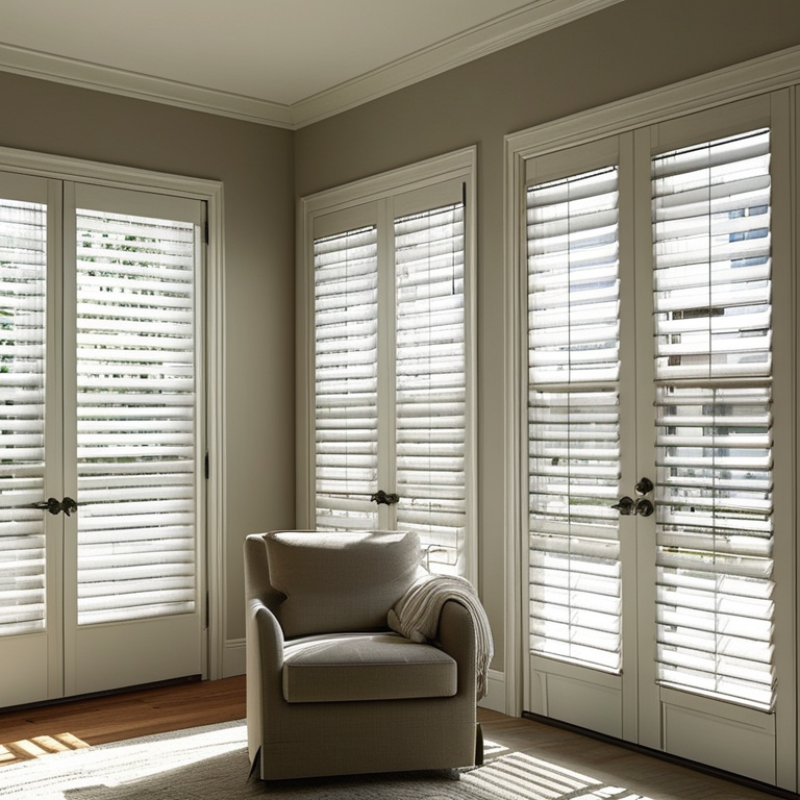
Choosing faux wood Venetian blinds starts with material facts, not just color. The USDA Forest Products Laboratory’s Wood Handbook reports common wood densities from about 0.3 to 0.9 g/cm³. Rigid PVC, used in many faux wood slats, typically measures about 1.3–1.45 g/cm³, according to PlasticsEurope PVC industry data. This difference can make faux wood blinds noticeably heavier. Check the headrail and mounting brackets carefully.
Tip: Ask for the exact PVC content. “Faux wood” may describe solid PVC, wood-plastic composite, or coated composite material. These options do not perform identically. A higher PVC percentage usually improves moisture resistance, but it may also increase weight. Product labels are sometimes vague. That deserves a second look.
Moisture resistance is the practical advantage. PVC itself absorbs very little water, while real wood can swell, warp, or change shape after repeated humidity exposure. The ASTM D570 water-absorption test provides useful laboratory data, but test results vary by formulation and coating. Installations near kitchens, bathrooms, and laundry areas need sealed edges and strong hardware. Real wood can still work in dry rooms and feels lighter, warmer, and more natural. Faux wood may resist moisture better, yet it is not automatically waterproof. Inspect the slat joints, tilt mechanism, and cut ends before buying.

Faux wood blinds typically contain a high proportion of PVC or PVC-based composite material, making them more resistant to humidity and moisture. Real wood blinds contain no PVC, are usually lighter, and require more care in damp rooms. The figures shown are representative material benchmarks; actual weight and composition vary by slat width, thickness, and construction.
Slat size changes how a window feels. A 1.5-inch blind suits narrow windows, shallow frames, and small rooms. Its tighter spacing creates a tailored look, but it may need more tilting for clear views. A 2-inch blind is the practical middle choice. It balances daylight, privacy, and cleaning. On wide windows, 2.5-inch slats often look calmer and more proportional. They show more glass when opened. Measure the window width, height, frame depth, and nearby handles before choosing.
Scale matters more than trends. I usually compare a sample against the frame, not a phone screen. A large slat can overwhelm a small sash. A tiny slat may look busy across a broad opening. The U.S. Department of Energy reports that roughly 76% of summer sunlight reaching standard double-pane windows enters as heat. Slat angle can reduce direct glare, but it cannot replace good glass or exterior shading. The National Fenestration Rating Council evaluates window performance through U-factor and solar heat gain coefficient, not slat width. Treat blinds as part of the system.
Faux wood also adds visual weight. White 1.5-inch slats can brighten a compact kitchen. Warm 2.5-inch slats may suit a deep living-room window. Moisture-resistant materials help, though “waterproof” claims deserve careful checking. I once chose oversized slats for a narrow opening; the room looked heavier than expected. A smaller sample would have exposed that mistake. Consider sightlines, cleaning access, and the view before ordering.
For faux wood Venetian blinds, accurate measuring matters more than decorative finish. Use a rigid steel tape, not cloth. Check the window in daylight. For an inside mount, measure the recess width at the top, middle, and bottom. Record the smallest number. Then measure height on the left, center, and right. Use the longest height. This helps the blind fit without forcing the frame.
Outside-mount blinds sit over the opening and need deliberate overlap. Measure the window width, then add the overlap recommended by the fitting guide, often 2 to 3 inches on each side. Add height above and below the opening as well. More overlap improves privacy and reduces edge light. Check nearby handles, vents, and wall trim. They can stop the blind from hanging flat. Measure the actual frame, not only the glass.
Write every measurement as width by height, and label inside or outside mount. Do not subtract from an outside-mount width unless the instructions require it. For inside mounts, never round up casually. A small error can make a slat scrape the recess. I once trusted a single top measurement and missed a tapered frame; the blind fit, but the gaps looked uneven. That mistake still matters. Recheck after removing old hardware, because brackets can change the usable space. If the recess is shallow, compare the headrail depth before ordering. Precision is quiet work.
When choosing faux wood Venetian blinds, examine more than color and slat width. Check how tightly the slats close. Small gaps can create visible glare and uneven heat near a window. Ask for NFRC-rated data when available, but verify what the rating covers. NFRC values usually describe the complete window system, not every blind attachment.
A lower U-factor indicates better resistance to heat transfer. This matters beside a cold bedroom window in winter. A higher U-factor may allow indoor warmth to escape faster.
SHGC measures how much solar heat enters through the glazing. Lower SHGC values can help in sunny rooms, especially with west-facing windows. Yet very low solar gain may reduce useful winter warmth in cooler climates.
Compare the blind with the existing glass, frame, and installation. Do not rely on a single impressive number. Look for independently documented figures, testing conditions, and product limitations. Faux wood can feel substantial, but its weight alone does not prove strong insulation. Leave minimal side gaps, mount the headrail securely, and close the slats before afternoon sun reaches the room. Test the room yourself.
Keep notes.
Seasonal results can differ. I have seen a blind reduce glare while doing little for drafts caused by the window frame. That is easy to miss. Recheck U-factor and SHGC information before ordering, and question vague claims that lack test details.
Choosing faux wood Venetian blinds involves more than matching slat color to your walls. Safety should guide every decision, especially in rooms used by children or pets. Choose a genuinely cordless design whenever possible. Fewer accessible cords mean fewer entanglement hazards. However, cordless does not mean risk-free.
Check the product description, packaging, and installation instructions for ANSI/WCMA A100.1-2022 compliance. Ask the seller for clear documentation if the information seems vague. Do not rely on a small safety icon alone. Inspect the blind before installation. Look for exposed loops, loose pull cords, sharp edges, or poorly secured components. Test the lift several times. It should move smoothly without sudden drops. A practical test matters more than attractive product photos.
Measure the window carefully, including frame depth and nearby furniture. A blind that rubs against a handle may become difficult to operate. Mount brackets firmly into suitable material, and follow the supplied instructions rather than guessing. Keep beds, chairs, and toy boxes away from the window area. Even a cordless blind may have internal mechanisms that need regular checking. Dust can affect movement over time. I would also recheck the blind after a few weeks, because a secure installation can loosen slightly. That small step is easy to overlook. Reliable safety comes from the product, the installation, and daily habits working together.
| Priority | Selection Dimension | What to Check | Safety or Performance Reason | Recommended Evidence |
|---|---|---|---|---|
| 1 | Cordless lift design | Choose a blind that raises and lowers without an exposed operating lift cord or loop. | Removing accessible lift cords and loops reduces a major window-covering strangulation hazard for young children. | Product photographs, operating instructions, and a hands-on demonstration before purchase. |
| 2 | ANSI/WCMA A100.1-2022 compliance | Ask whether the complete window-covering product has been tested and documented against ANSI/WCMA A100.1-2022. | ANSI/WCMA A100.1-2022 is a recognized U.S. safety standard for corded window-covering products and related safety requirements. | A dated test report, supplier declaration, or written compliance statement identifying the exact product configuration. |
| 3 | Accessible cords and loops | If any cord, chain, or loop is present, check whether it can be reached from the floor, nearby furniture, or a child-accessible location. | Accessible continuous loops and pull cords can create entanglement and strangulation risks. | Inspect the installed position, nearby furniture, cord guides, tension devices, and safety instructions. |
| 4 | Installation and mounting strength | Confirm that the headrail, brackets, screws, and wall or window-frame anchors match the installation instructions. | Correct mounting helps prevent the blind from falling and ensures that safety features work as intended. | Clear installation instructions, compatible hardware, and a qualified installer when the substrate is uncertain. |
| 5 | Child-safe placement | Keep beds, cribs, sofas, chairs, and other climbable furniture away from the window-covering operating area. | Furniture can give children access to cords, loops, and moving blind components that would otherwise be out of reach. | A room-by-room placement plan completed before measuring and installation. |
| 6 | Slat and tilt durability | Operate the tilt mechanism and inspect that slats move evenly without sharp edges, loose pieces, or excessive resistance. | Smooth operation reduces the likelihood of breakage, loose components, or improvised repairs that may introduce hazards. | Sample inspection, operating-cycle information, warranty terms, and replacement-part availability. |
| 7 | Material, size, and room suitability | Verify slat size, blind width, window depth, moisture exposure, and the product’s cleaning and care requirements. | The correct size and environment help maintain stable operation and reduce premature warping, damage, or installation problems. | Accurate measurements, product specifications, moisture limitations, and written care instructions. |
Safety reminder: No window covering is completely risk-free. Follow the installation and safety instructions, keep cords and loops out of children’s reach, and regularly inspect the blind for damage or loose parts.

Signup our newsletter to get update information, promotion or insight.