Blog

China Top Zebra Window Blinds Manufacturer and Supplier

Choosing a China-based Zebra Window Blinds manufacturer requires more than comparing catalog prices. Quality appears in small details: straight fabric stripes, smooth chain movement, accurate tube cutting, and clean stitching around every edge. A reliable supplier should explain fabric composition, light-filtering performance, child-safety features, and installation requirements clearly. It should also provide samples before large-scale production.

Window-covering consultant Deb Barrett offers a useful principle: “The best window treatment serves the room before it follows the trend.” This idea fits Zebra Window Blinds well. Their alternating sheer and opaque bands can soften daylight, improve privacy, and create a calmer interior. However, results depend on correct measurements, fabric tension, and thoughtful color selection. A beautiful sample cannot rescue poor installation.

China’s mature manufacturing network supports custom sizes, private labeling, motorized options, and flexible packaging. Still, buyers should inspect more than factory photographs. Ask for material data, production photos, quality-control procedures, and sample approval records. Confirm how the supplier handles color consistency across batches. Request clear lead times and shipping documents.

The cheapest quotation may not be the lowest total cost. Sometimes, it hides weaker components. Sometimes, expectations were simply unclear. That part deserves reflection.

A dependable Zebra Window Blinds supplier combines practical experience, responsive communication, stable production, and transparent after-sales support. For distributors, contractors, and property developers, this balance builds long-term confidence. The right manufacturer does not only sell blinds. It helps buyers create dependable shading solutions for real rooms, changing light, and daily use.

China Top Zebra Window Blinds Manufacturer and Supplier

Zebra Window Blinds: Dual-Layer Design and 1%–5% Openness Factors

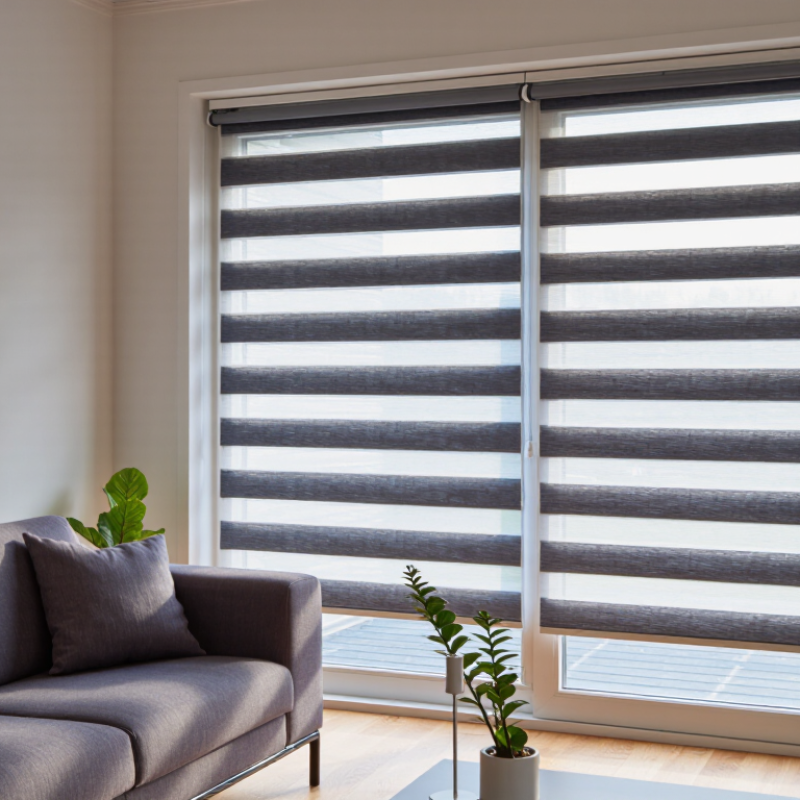
Zebra window blinds use two fabric layers with alternating sheer and solid bands. Moving the shade aligns or overlaps these bands. This creates adjustable light control without fully raising the blind. The dual-layer design works well in bedrooms, offices, and living rooms. During daytime, sheer sections soften sunlight across desks and floors. At night, overlapping solid bands improve privacy. They do not replace complete blackout systems.

Openness factors usually range from 1% to 5%. A 1% fabric filters stronger sunlight and offers better daytime privacy. A 3% option balances brightness, visibility, and room comfort. A 5% option allows more natural light and an open outdoor view. However, openness performance changes with interior lighting and window direction. South-facing rooms may need a lower factor. North-facing rooms can often use a higher one.

Accurate measurement matters more than many buyers expect. Small gaps can create bright lines along the frame. A reliable manufacturer or supplier should explain fabric density, tube strength, control options, and installation limits. Sample testing near the actual window is useful. Colors can appear different beside warm walls or dark flooring. I have found that choosing the darkest fabric is not always the best answer. It may reduce glare, but it can also make a small room feel heavy. Regular dusting and gentle cleaning help preserve smooth movement. Exact results still depend on installation quality.

Key Materials, Sizes, Light Control, and UV-Blocking Performance

China Top Zebra Window Blinds Manufacturer and Supplier

Key Materials, Sizes, Light Control, and UV-Blocking Performance

Zebra blinds usually combine polyester yarns with sheer and solid fabric bands. Polyester resists stretching and keeps pleats stable in humid rooms. Some suppliers add acrylic coatings for stronger glare control. However, coated fabric can feel stiffer. That trade-off deserves attention.

Standard widths often range from 40 to 250 centimeters, while custom sizes suit large glass doors and narrow kitchen windows. Accurate measurement matters. A two-millimeter error can create visible light gaps. Zebra blinds also offer adjustable light control through aligned or overlapping stripes. The U.S. Department of Energy reports that windows can cause 25–30% of household heating and cooling energy use. Better shading may reduce indoor heat, but results depend on glass, orientation, and climate. It is not magic.

Tips: Ask for fabric openness, visible light transmission, and UV test results. AATCC TM183 can evaluate ultraviolet transmission through textile materials. Request batch-level testing, not only a general product claim. For strong sunlight, choose denser fabric and mount the blind close to the frame. Leave ventilation space where moisture is common. Dark fabric may block glare well, but it can absorb more solar heat. Measure performance, not appearance.

China Top Zebra Window Blinds Manufacturer and Supplier: Key Materials, Sizes, Light Control, and UV-Blocking Performance

Zebra window blinds commonly use coated polyester or polyester-blend fabrics. Standard finished widths are often available from approximately 600 to 2400 mm, with heights commonly ranging from 1000 to 3000 mm. The chart presents representative performance values for different shade positions; actual light transmission and UV reduction vary by fabric construction, color, glazing, and installation.

Sheer alignment provides filtered daylight, the intermediate position balances privacy and brightness, and the closed position delivers the strongest light control and solar protection. Polyester fabrics are widely used because they offer dimensional stability, cleanability, and consistent color performance.

China’s Manufacturing Process: Fabrication, Assembly, and Quality Inspection

China Top Zebra Window Blinds Manufacturer and Supplier

China’s manufacturing process begins with fabric fabrication. Polyester yarn is woven into alternating sheer and opaque bands. Coating, dyeing, and heat-setting follow. Operators check width, color, density, and alignment under controlled lighting. A small weave defect can become obvious after installation. I have seen this issue during roll inspection. It is easy to underestimate.

During assembly, fabric rolls are cut according to approved measurements. Tubes, bottom rails, brackets, and control systems are fitted with calibrated tools. Each blind receives functional checks for smooth rotation, level movement, and fabric positioning. The U.S. Department of Energy reports that windows influence about 25%–30% of residential heating and cooling energy use. This does not mean every zebra blind delivers equal savings. Installation gaps, fabric openness, and room orientation still matter. Quality inspection should include sampling plans, dimensional checks, color comparison, and repeated operating cycles. ISO 2859-1 provides a recognized framework for lot-by-lot sampling, although factories sometimes apply it too mechanically.

Tips: Request a pre-production sample, inspection records, and fabric test results. Confirm tolerances in writing. Ask how failed units are isolated. A strong supplier explains weaknesses, not only advantages. For export orders, carton drop tests, moisture protection, and barcode traceability reduce avoidable claims. Human inspection remains valuable, but it can miss patterns across thousands of units. Data records should support it, not replace practical judgment.

China Top Zebra Window Blinds Manufacturer and Supplier - China’s Manufacturing Process: Fabrication, Assembly, and Quality Inspection

Manufacturing Stage Main Operations Typical Materials or Inputs Key Process Controls Typical Equipment Quality Inspection and Acceptance Criteria
1. Incoming Material Inspection Receive, identify, sample, and approve raw materials before production. Polyester or polyester-blend fabric, aluminum tubes, bottom rails, brackets, chains, motors, fasteners, and packaging materials. Material identification, quantity verification, color-lot control, dimensional checks, and supplier documentation review. Measuring tape, digital caliper, weighing scale, color-matching light source, and inspection table. No visible tears, stains, corrosion, deformation, or mixed color lots; dimensions and material specifications must match the approved purchase requirements.
2. Fabric Preparation and Cutting Unroll, condition, align, measure, and cut the fabric into alternating sheer and opaque bands. Coated or uncoated polyester fabric supplied in continuous rolls. Fabric direction, band alignment, cut length, roll tension, and allowance for the finished headrail and bottom rail. Fabric inspection machine, computerized cutting table, rotary cutter, and measuring system. Cut edges should be straight and clean; pattern and stripe alignment should remain consistent; finished cut size should comply with the work order tolerance.
3. Fabric Joining and Bottom-Rail Preparation Join fabric sections where required, form the bottom pocket, and prepare the fabric for insertion into the bottom rail. Polyester fabric, thread, heat-sealing materials, adhesive components, or compatible bottom-rail inserts. Seam position, stitch density, heat-sealing temperature, adhesive coverage, and fabric flatness. Industrial sewing machine, ultrasonic or heat-sealing equipment, edge guide, and pressing tools. Seams must be secure and free from skipped stitches; no excessive puckering, fraying, bubbling, or adhesive overflow is permitted.
4. Headrail and Component Fabrication Cut and deburr headrails, prepare end caps, install drive components, and assemble brackets and control parts. Aluminum or steel headrail sections, end caps, drive tubes, clutch mechanisms, chains, brackets, and fasteners. Cut length, hole position, component orientation, burr removal, screw torque, and compatibility between drive parts. Automatic saw, drilling machine, deburring tools, torque screwdriver, and assembly fixtures. Metal parts must be straight and free from sharp edges; brackets and drive components must be firmly secured and correctly oriented.
5. Roll Assembly Attach the fabric to the rotating tube, install the bottom rail, fit end caps, and mount the assembled blind into a test fixture. Prepared zebra fabric, aluminum tube, bottom rail, end caps, clutch or motor, and mounting hardware. Fabric centering, winding direction, tube runout, bottom-rail level, and clearance between moving components. Assembly bench, alignment fixture, winding tool, electric screwdriver, and level gauge. Fabric must roll smoothly without telescoping, creasing, or rubbing; the bottom rail should remain level during operation.
6. Manual or Motorized Control Installation Install chain-control parts or connect the motor, power supply, receiver, and control system when applicable. Control chain, clutch, tubular motor, adapter, rechargeable battery, power supply, remote control, or wall switch. Electrical polarity, connector security, motor direction, upper and lower limits, battery connection, and control pairing. Low-voltage tester, continuity tester, programming handset, torque tester, and functional test stand. The blind must raise, lower, and stop correctly; controls must respond consistently; exposed electrical wiring must be insulated and secured.
7. Dimensional and Visual Inspection Inspect finished width, drop, fabric appearance, hardware position, and overall finish. Completed zebra blind and installation accessories. Finished-size measurement, band overlap, squareness, color consistency, surface condition, and accessory count. Steel rule, digital caliper, laser distance meter, level gauge, inspection lighting, and standard sample board. No noticeable stains, holes, loose threads, scratches, dents, sharp edges, or assembly gaps; finished dimensions must meet the approved order tolerance.
8. Functional and Durability Testing Operate the blind repeatedly, check alignment, and verify control stability under normal use conditions. Fully assembled manual or motorized zebra blind. Smooth rotation, consistent stopping position, fabric tracking, noise, chain movement, and motor response. Cycle-test stand, stopwatch, sound-level meter, and operating-force gauge. No jamming, abnormal noise, fabric slippage, uncontrolled movement, or loss of function during the defined internal cycle test.
9. Fabric Performance Inspection Verify selected fabric characteristics according to the required product specification. Finished or production-lot fabric samples. Fabric weight, thickness, light transmission, colorfastness, coating adhesion, and visual uniformity. Thickness gauge, GSM balance, light box, spectrophotometer, and laboratory testing equipment. Results must comply with the approved technical specification; testing methods may include relevant ASTM, ISO, or AATCC procedures where specified by the buyer.
10. Safety and Compliance Review Review cord or chain safety, mounting hardware, electrical protection, warning labels, and installation instructions. Control chains, cord-free mechanisms, motors, brackets, labels, user instructions, and packaging inserts. Accessible-loop control risks, secure anchoring, electrical insulation, label legibility, and required documentation. Pull-force gauge, electrical safety tester, label inspection board, and installation test fixture. Safety features must be installed and functional; applicable requirements may include EN 13120 or ANSI/WCMA A100.1, depending on the destination market and product configuration.
11. Final Inspection and Packaging Clean, label, protect, and pack the finished blinds and accessories for shipment. Finished blinds, protective film, cartons, corner protectors, installation kits, labels, and instruction sheets. Product identification, accessory completeness, carton strength, barcode accuracy, and packaging protection. Barcode scanner, weighing scale, carton sealer, label printer, and packing inspection table. Correct product and quantity must be packed; cartons must be sealed, undamaged, clearly labeled, and protected against abrasion and impact.
12. Traceability and Shipment Release Review inspection records, assign batch identification, authorize release, and retain production documentation. Inspection reports, material records, production orders, batch codes, packing lists, and shipment documents. Batch traceability, nonconformance disposition, quantity reconciliation, and release authorization. Quality management database, document-control system, barcode scanner, and shipment checklist. Only products with completed inspection records and approved nonconformance status should be released for shipment.
Note: Actual tolerances, fabric performance values, electrical requirements, and safety tests should be confirmed against the approved product specification and the regulations of the destination market.

Safety and Compliance: EN 13120 and ANSI/WCMA A100.1 Standards

As a China-based zebra window blinds manufacturer and supplier, we treat safety as a design requirement. It cannot be added after production. Zebra blinds combine alternating sheer and opaque fabric panels, moving cords, chains, and operating mechanisms. Each part needs controlled movement and secure assembly. Requirements associated with EN 13120 guide risk reduction for internal window coverings in European markets. ANSI/WCMA A100.1 provides safety expectations for window covering products sold in the United States. These standards address accessible cords, operating components, product strength, warnings, and installation information.

Testing should reflect real homes, not only clean factory samples. We inspect cord access, chain tension, clutch performance, fabric alignment, and mounting brackets. We also check whether a child could reach a loop near a bed or chair. Small details matter. A warning label alone is not protection. Clear instructions and suitable installation hardware matter just as much. Documentation should record material batches, inspections, test results, and corrective actions. That evidence supports reliable supplier communication and consistent production.

Real installations are less tidy than test rooms. Windows vary, furniture moves, and users sometimes ignore instructions. We still review those weak points. A safer design may use cordless operation, restrained loops, or concealed control systems where appropriate. Compliance claims must match the tested product configuration. A minor fabric change, hardware substitution, or control-length adjustment can require renewed evaluation. This disciplined approach helps buyers select zebra blinds with practical safety, traceable quality, and standards-aware manufacturing.

How to Evaluate China’s Top Zebra Blinds Manufacturers and Suppliers

China Top Zebra Window Blinds Manufacturer and Supplier

When evaluating China’s top zebra blinds manufacturers, begin with production evidence, not attractive catalog photos. Experienced suppliers should explain fabric composition, light control, tube strength, and operating systems clearly. Request physical samples before discussing large orders. Samples reveal details. Check stripe alignment, stitching, edge cutting, and the smoothness of the chain or motor. A reliable factory should provide recent quality records, material specifications, and applicable safety documentation. It should also explain how it controls color variation between batches.

Visit the production site when possible, or arrange a professional video audit. Observe fabric storage, cutting accuracy, assembly stations, and final inspection procedures. Ask how defects are recorded and corrected. Good communication matters as much as equipment. Confirm lead times, packaging methods, replacement policies, and responses to warranty issues in writing. In my sourcing experience, a supplier may promise fast delivery but overlook packaging tests. That mistake can damage finished blinds before installation. No factory is perfect. Honest suppliers admit limitations and describe practical solutions.

Tips: Compare at least three suppliers using the same checklist. Ask for a pre-production sample and an inspection report. Test blackout performance, size tolerance, and operating noise. Do not judge quality by the lowest quote alone. A cheaper fabric or weaker mechanism may create higher replacement costs later. Also review export experience for your destination market, because labeling and installation expectations can differ.